
Water Filter
Replaces: Unfiltered Tap Water
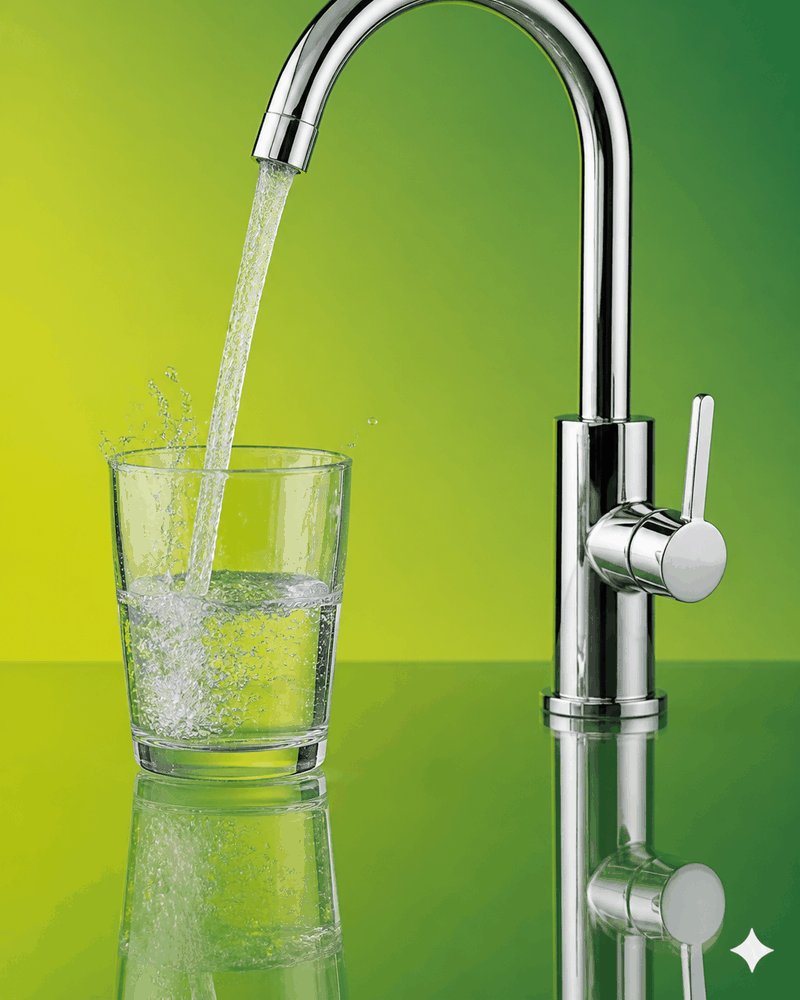 The Problem
 Unfiltered Tap Water
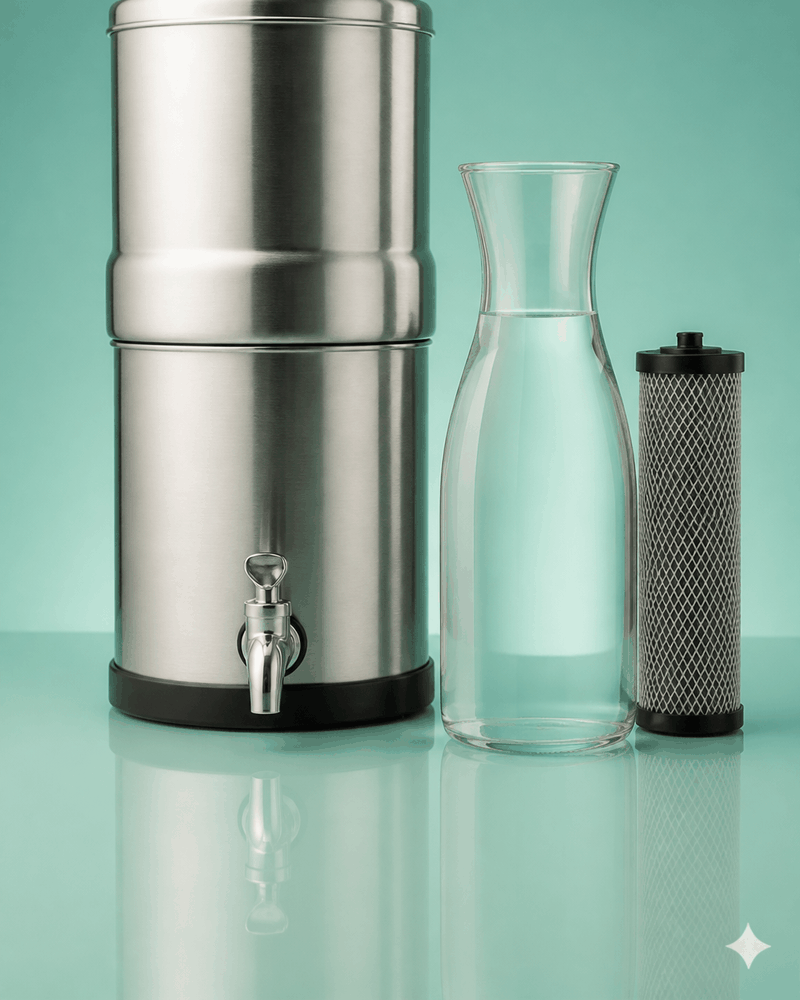 The Solution
 Water Filter
Water Filter
Replaces: Unfiltered Tap Water
Shop Now →Why Switch?
Municipal treatment does the hard work of making water microbiologically safe. What it was never designed for is the modern chemistry that has since turned up in source water, and the last few metres of pipe before your tap.
PFAS. A US Geological Survey national reconnaissance published in Environment International in 2023 sampled tap water at the point of use from 716 locations — 269 private wells and 447 public supplies — testing for 32 PFAS compounds. It found 1–9 individual PFAS per sample, cumulative concentrations spanning 0.348–346 ng/L, and estimated that at least one PFAS could be detected in about 45% of US drinking water. Notably, profiles and median concentrations were similar between unregulated private wells and regulated public supplies. On health effects, the National Academies concluded in 2022 that there is evidence of association between PFAS exposure and decreased antibody response, dyslipidemia, reduced infant and fetal growth, and increased kidney cancer risk.
Lead. This one does not come from the treatment plant at all — it comes from lead service lines, solder, and brass fittings inside your own building, which is precisely why a utility can report compliant water while your kitchen tap delivers something else. EPA sets the goal for lead at zero because there is no known safe blood lead level in children, where low-level exposure is linked to lower IQ, attention and behaviour problems, slowed growth, and anemia. Infants fed formula made with contaminated water get a proportionally higher dose. Lead cannot be seen, tasted, or smelled.
Chlorination by-products. Disinfecting water is unambiguously worth doing, but chlorine reacts with organic matter to form trihalomethanes and haloacetic acids, and a pooled analysis of European case-control studies found a consistent association between long-term exposure and bladder cancer risk in men.
What Makes It Better
A filter treats water where you actually drink it — after your own plumbing, which is downstream of everything the utility can control.
The key evidence here supports a specific recommendation rather than a general one. Independent testing published in Environmental Science & Technology Letters in 2020 evaluated filters in 73 North Carolina homes across 16 PFAS compounds. All under-sink dual-stage and reverse osmosis systems showed near-complete removal — at least 90% for the main PFAS classes and 97% or better for most perfluoroalkyl ether acids. Every other activated-carbon option, including pitchers, countertop, faucet-mounted, refrigerator, and single-stage carbon-block under-sink filters, showed variable removal that depended on chain length: roughly 60–70% for long-chain PFAS but only about 40% for short-chain, with no clear relationship to brand, age, or incoming concentration.
So if PFAS removal is the goal, reverse osmosis or a dual-stage under-sink system is the evidence-supported choice. A certified carbon block is a reasonable cheaper option that also handles chlorine, chloramine, trihalomethanes, and lead — just do not assume it covers PFAS.
The side effect people notice first is taste. Removing chlorine changes water, tea, and coffee immediately, which is usually what converts the rest of the household, and it ends the reason to buy bottled water.
Honest Caveats
An unmaintained filter can be worse than no filter. In the same study, among eight whole-house point-of-entry carbon systems, four of the eight showed higher PFAS in the filtered water than went in — presumably breakthrough from exhausted media. Replace cartridges on schedule, and do not use whole-house carbon as your PFAS strategy.
Certification does not yet mean “removes PFAS to EPA’s limits.” Look for NSF/ANSI 53 for filters, 58 for reverse osmosis, and 401 for emerging contaminants, and verify the specific claim in the certifier’s directory. But EPA states plainly that current certification standards focus on PFOA and PFOS specifically and do not yet indicate a filter will reduce PFAS down to the levels EPA has set. The honest claim is “reduces PFOA and PFOS,” not “removes PFAS.”
The US regulatory picture is in flux, so check it before relying on it. EPA’s 2024 rule set enforceable limits of 4 ppt for PFOA and PFOS and 10 ppt for three other compounds. In 2026 EPA proposed both upholding the PFOA/PFOS limits while allowing systems to request until 2031 to comply, and rescinding the limits for PFHxS, PFNA, GenX, and the mixture Hazard Index. Utilities are also still largely in the monitoring phase, so an absence of reported exceedances does not mean an absence of PFAS.
Match the filter to your actual water. The 45% figure is a national estimate of detection, not of exceedance or of harm — cumulative concentrations in that study spanned three orders of magnitude, and it covered 32 of the 12,000-plus known PFAS. Read your utility’s annual Consumer Confidence Report, check your state’s PFAS data, and find out whether you have a lead service line, then buy a filter certified for what you actually have. Reverse osmosis also sends a reject stream down the drain and strips beneficial minerals and fluoride, which matters if children in the house rely on fluoridated water; some systems remineralise.
Key Benefits
- Reverse osmosis and dual-stage under-sink systems showed near-complete PFAS removal in independent testing
- Captures lead picked up from your own pipes, downstream of the utility’s testing point
- Reduces chlorination by-products associated with bladder cancer risk
- Noticeably better taste in water, tea, and coffee
- Far cheaper than bottled water, with no plastic bottles
- Treats water at the point of use, so nothing downstream recontaminates it
The Research
- Smalling K.L., et al. (2023). “Per- and polyfluoroalkyl substances (PFAS) in United States tapwater: Comparison of underserved private-well and public-supply exposures and associated health implications.” Environment International. — doi.org/10.1016/j.envint.2023.108033
- Herkert N.J., et al. (2020). “Assessing the Effectiveness of Point-of-Use Residential Drinking Water Filters for Perfluoroalkyl Substances (PFASs).” Environmental Science & Technology Letters. — doi.org/10.1021/acs.estlett.0c00004
- National Academies of Sciences, Engineering, and Medicine (2022). “Guidance on PFAS Exposure, Testing, and Clinical Follow-Up.” National Academies Press. — doi.org/10.17226/26156
- US Environmental Protection Agency (2024). “PFAS National Primary Drinking Water Regulation.” Federal Register, 89 FR 32532. — govinfo.gov
- US Environmental Protection Agency. “PFAS Rule Implementation” (current status and 2026 proposed changes). — epa.gov/dwreginfo/pfas-rule-implementation
- US Environmental Protection Agency. “Identifying Drinking Water Filters Certified to Reduce PFAS.” — epa.gov
- US Environmental Protection Agency. “Basic Information about Lead in Drinking Water.” — epa.gov
- Villanueva C.M., Cantor K.P., Cordier S., et al. (2004). “Disinfection byproducts and bladder cancer: a pooled analysis.” Epidemiology. (Link pending verification.)