
Organic Cotton Sheets
Replaces: Polyester Sheets
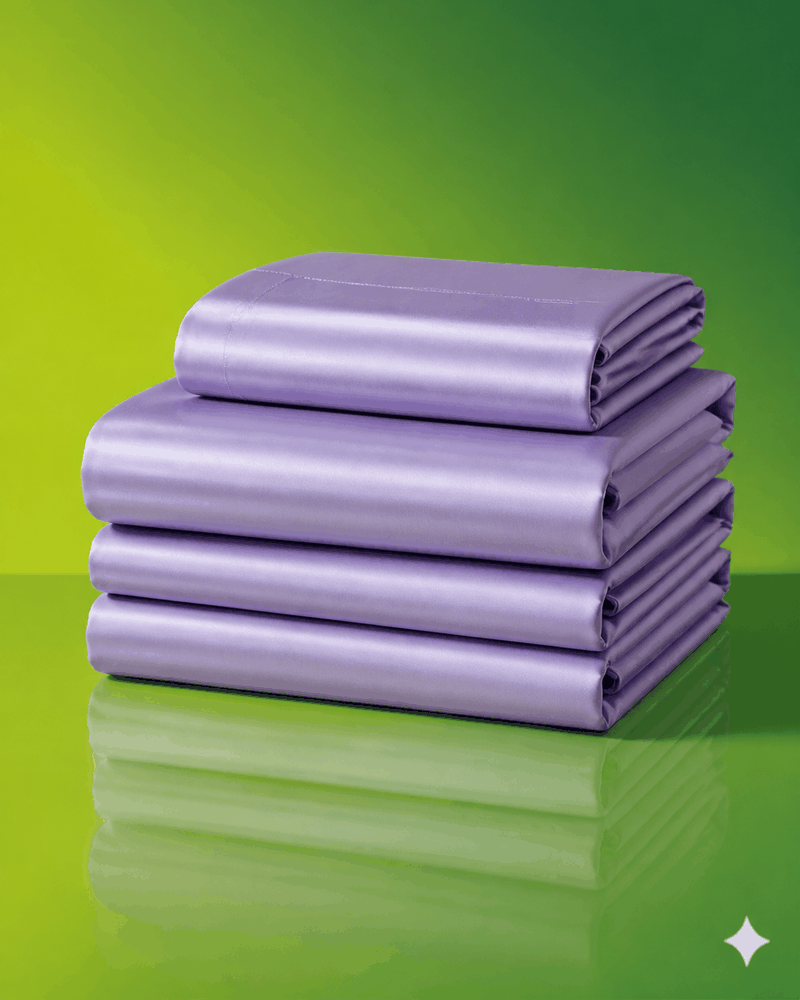 The Problem
 Polyester Sheets
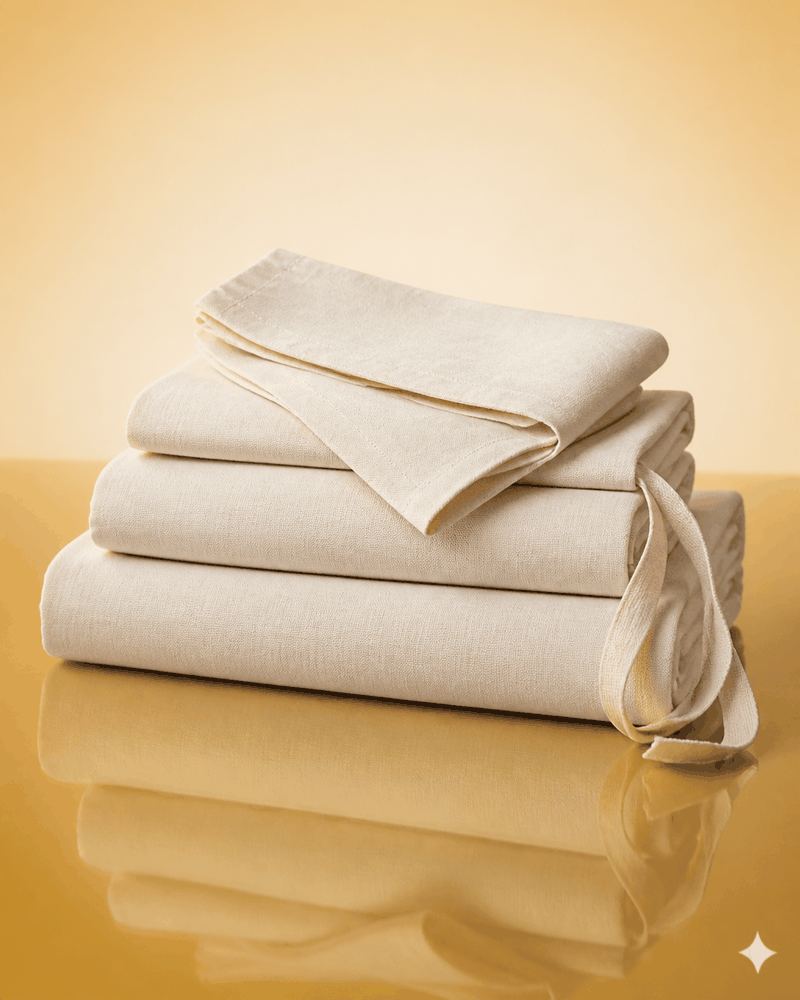 The Solution
 Organic Cotton Sheets
Organic Cotton Sheets
Replaces: Polyester Sheets
Shop Now →Why Switch?
Polyester sheets are marketed as “microfibre,” which sounds technical and pleasant. It means finely extruded PET plastic — the same polymer as a water bottle, spun into thread.
Three things ride along with it. First, the polymerisation catalyst: antimony trioxide is the standard catalyst for making PET, it remains in the finished fibre at measurable levels, and the International Agency for Research on Cancer classifies it as possibly carcinogenic to humans (Group 2B). Second, the finishes. “Wrinkle-free,” “easy-care,” and “no-iron” bedding is typically treated with formaldehyde-releasing resins, and formaldehyde is a Group 1 known human carcinogen and a well-documented skin sensitiser — a review in Contact Dermatitis covers formaldehyde releasers and contact allergy in detail. Stain-resistant finishes are a separate issue: research in Environmental Science & Technology found PFAS in textiles marketed as stain-resistant, including children’s clothing.
Third, the dyes. Polyester will not take ordinary dyes, so it requires disperse dyes, and a review in Contact Dermatitis identifies these as the leading cause of textile contact dermatitis. Because disperse dyes are small and poorly fixed, they are prone to rubbing off — and warmth plus overnight perspiration is precisely the condition that mobilises them.
The comfort problem is physics. Polyester does not absorb moisture; it repels it. So sweat has nowhere to go and you wake up clammy. And every wash sheds plastic — a study in Scientific Reports quantified the microfibre release from laundering synthetic textiles, on the order of hundreds of thousands of fibres per wash.
What Makes It Better
Cotton is a hollow cellulose fibre that absorbs roughly a quarter of its weight in moisture and releases it into the air, which is the whole reason cotton bedding feels cool and dry. Air moves through the weave instead of being blocked by it, so body heat dissipates rather than building up under a plastic sheet.
Certified organic is what closes the loop on the chemistry. GOTS certification governs the entire processing chain, not just the farming: it prohibits formaldehyde finishes, restricts dyes to those meeting toxicity and biodegradability criteria, bans PFAS and chlorine bleaching, and requires third-party verification. That means the sheet arriving at your house has no resin finish, no PFAS, and no antimony catalyst — because there is no synthetic polymer to catalyse.
Good cotton also improves with use. It softens with every wash for years, whereas polyester pills, develops a shiny worn patch, and holds odour because bacteria feed on the oils that sit on the surface of a non-absorbent fibre instead of wicking away.
Honest Caveats
Cotton wrinkles — that is the direct trade-off for having no wrinkle-free resin, and pulling sheets out of the dryer slightly damp and smoothing them by hand handles most of it. Organic cotton costs more and is less durable than polyester in pure abrasion terms, though it stays comfortable far longer. Ignore thread count as a quality signal; fibre length matters much more, so look for long-staple cotton. Most importantly, look for GOTS on the finished product rather than a vague “made with organic cotton” claim, which can cover an item that was still finished with conventional chemistry. Oeko-Tex Standard 100 is a useful second-best, since it tests the finished textile for harmful substances even if the farming was not organic.
Key Benefits
- No antimony trioxide catalyst residue and no PET plastic against your skin
- GOTS certification prohibits formaldehyde finishes, PFAS, and chlorine bleaching
- Avoids disperse dyes, the leading cause of textile contact dermatitis
- Breathes and absorbs moisture, so you sleep cool and dry instead of clammy
- Sheds no plastic microfibres into your wash water
- Softens with every wash rather than pilling and going shiny
- Holds odour far less, because sweat wicks away instead of sitting on the fibre
The Research
- IARC Monographs Volume 47. “Antimony trioxide and antimony trisulfide.” International Agency for Research on Cancer.
- IARC Monographs Volume 100F. “Formaldehyde.” International Agency for Research on Cancer.
- de Groot A.C., Flyvholm M.A., Lensen G., et al. (2009). “Formaldehyde-releasers: relationship to formaldehyde contact allergy.” Contact Dermatitis.
- Malinauskiene L., Bruze M., Ryberg K., et al. (2013). “Contact allergy from disperse dyes in textiles: a review.” Contact Dermatitis.
- Xia C., Diamond M.L., Peaslee G.F., et al. (2022). “Per- and Polyfluoroalkyl Substances in North American School Uniforms.” Environmental Science & Technology.
- De Falco F., Di Pace E., Cocca M., Avella M. (2019). “The contribution of washing processes of synthetic clothes to microplastic pollution.” Scientific Reports.