
Beeswax Candle
Replaces: Plug-In Air Freshener
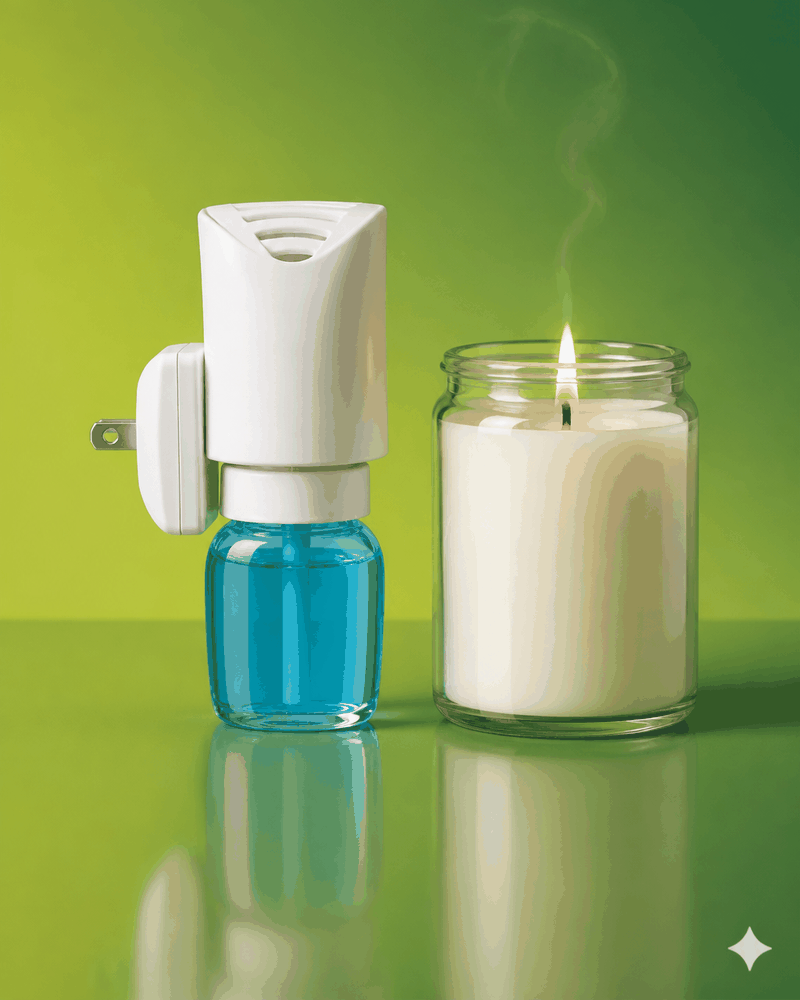 The Problem
 Plug-In Air Freshener
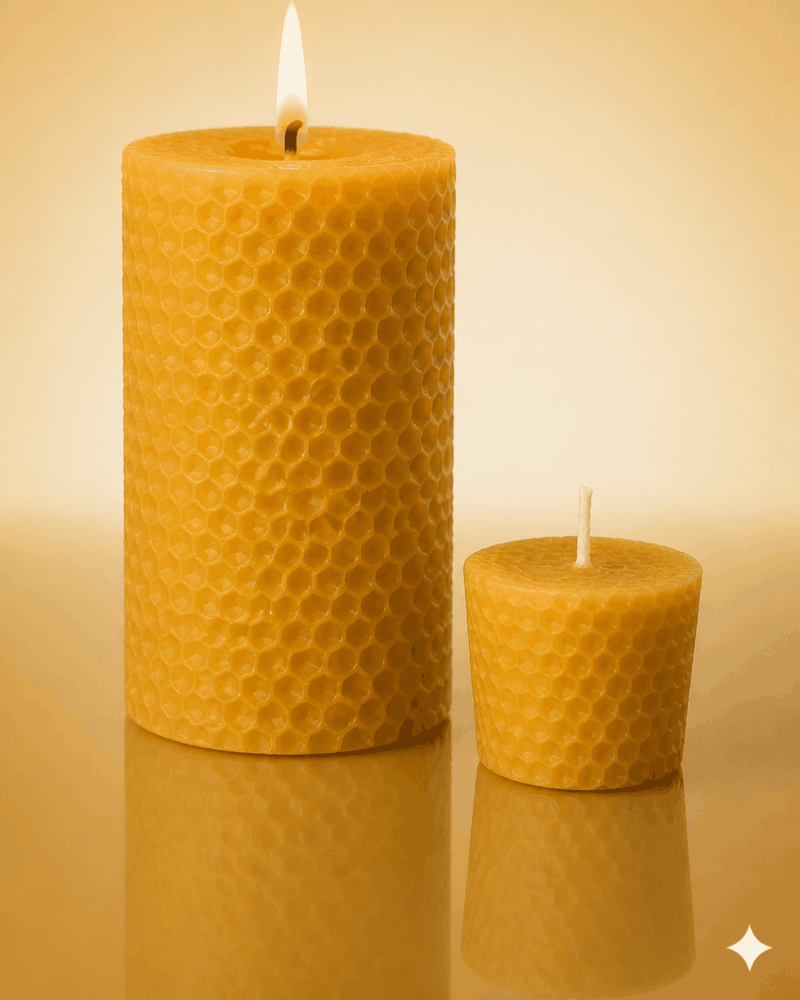 The Solution
 Beeswax Candle
Beeswax Candle
Replaces: Plug-In Air Freshener
Shop Now →Why Switch?
An air freshener does not remove odour. It adds chemicals to your air to cover it, and a plug-in does this continuously for weeks, unattended, whether anyone is in the room or not.
The composition has been measured. A GC/MS analysis published in Environmental Impact Assessment Review examined best-selling fragranced products and found nearly 100 volatile organic compounds across six of them, ten regulated as toxic or hazardous under US federal law and three — acetaldehyde, chloromethane, and 1,4-dioxane — classified as Hazardous Air Pollutants. Not one appeared on any product label. Independent laboratory testing by the Natural Resources Defense Council found phthalates in 12 of 14 air fresheners, at up to 7,307 ppm, including products marketed as “all-natural” and “unscented,” with none declared.
The secondary chemistry is the part most people have never heard. The terpenes that create citrus and pine scents — limonene, alpha-pinene — react readily with ozone drifting in from outdoors. As set out in the Atmospheric Environment review of cleaning products and air fresheners, those reactions generate formaldehyde, hydroxyl radicals, and secondary organic aerosol. A product can emit no formaldehyde at all and still cause formaldehyde to appear in your room. Both formaldehyde and benzene are IARC Group 1 human carcinogens.
For health outcomes, the Avon Longitudinal Study of Parents and Children, reported in Archives of Environmental Health, linked frequent air freshener use to statistically significant increases in infant diarrhoea and earache, and to maternal headache and depression at eight months postpartum.
Flameless wax melts are not an escape hatch. A 2025 study in Environmental Science & Technology Letters found that scented wax melts trigger new-particle-formation events exceeding a million particles per cubic centimetre, with respiratory deposited dose rates rivalling gas stoves and diesel engines — precisely because they release terpenes without a flame.
What Makes It Better
The real win here is subtraction: removing a device that emits into your home around the clock. Ventilation, an open window, and baking soda or activated charcoal for actual odour absorption do more for air quality than any freshener. Because intake depends on emission duration and air exchange rate, eliminating a continuous source and opening a window is a far larger real-world reduction than switching which product you plug in.
When you do want ambience, the evidence points at one variable above all others: scented versus unscented, not which wax. A 2021 chamber study in Environment International burned 24 purpose-manufactured candles and found that wax type — paraffin, soy, palm, stearin — did not significantly drive the emission profile, while adding fragrance did, with formaldehyde and acetaldehyde significantly higher for “fresh” and “fruit” scents. An unscented 100% beeswax candle with a cotton wick gives you a warm light and a faint natural honey note without a fragrance load, and it burns slowly because beeswax has a higher melting point than paraffin or soy, so a candle lasts a long time.
Two claims this page will not make. There is no good evidence that beeswax candles release negative ions or purify air, so we are not repeating it. And “beeswax burns cleaner than paraffin” is not supportable either — the chamber research above found wax type was not the driver, and a Danish EPA survey found stearin candles averaged roughly twice the ultrafine particle count of paraffin. The defensible framing is: unscented beats scented, a steady flame beats a sooty one, and less burning with more ventilation beats any wax choice.
Honest Caveats
Every candle is combustion, and beeswax is no exception. A 1999 study in Environmental Science & Technology tested paraffin and beeswax and found all candles produce sub-100 nm particles during normal burning, heavy soot when sooting, and a particle burst on extinction. So ventilate, trim the wick to about 5mm, keep it out of draughts so the flame does not flicker, and do not burn candles constantly in a closed room.
Essential oil diffusers are not a clean substitute. Research in Air Quality, Atmosphere & Health found 188 distinct VOCs across 24 essential oils, 33 of them potentially hazardous, toluene in half the samples, and no significant difference between “natural” or organic oils and regular ones. Diffusing oils supplies exactly the terpenes that drive ozone-initiated formaldehyde formation. Dried lavender, cedar, or citrus peel sitting passively in a bowl does not.
Check labels, because “beeswax blend” is often mostly paraffin — you want 100% beeswax with a cotton or paper wick, never a metal-cored one. Beeswax costs more and is not vegan. And if anyone in the house has asthma, the best answer is no added scent at all: fix the odour source, ventilate, and skip the candle too.
Finally, the epidemiology here is associational and self-reported. The ALSPAC findings measured reported symptoms against reported product use, and the significant infant outcomes were diarrhoea and earache rather than asthma. Confounding by housing quality, ventilation, and smoking is plausible.
Key Benefits
- Removes a device emitting undisclosed VOCs and phthalates around the clock
- Stops the terpene-plus-ozone chemistry that forms formaldehyde indoors
- Unscented burning avoids the fragrance-driven formaldehyde and acetaldehyde rise measured in chamber testing
- Episodic and user-controlled rather than continuous and involuntary
- Beeswax burns slowly, so a candle lasts a long time
- Naturally faintly scented, so no fragrance oils needed
- Pushes you toward ventilation and odour absorption, which actually work
The Research
- Steinemann A.C. (2009). “Fragranced consumer products and undisclosed ingredients.” Environmental Impact Assessment Review. — doi.org/10.1016/j.eiar.2008.05.002
- Nazaroff W.W., Weschler C.J. (2004). “Cleaning products and air fresheners: exposure to primary and secondary air pollutants.” Atmospheric Environment. — doi.org/10.1016/j.atmosenv.2004.02.040
- Steinemann A. (2017). “Ten questions concerning air fresheners and indoor built environments.” Building and Environment. — doi.org/10.1016/j.buildenv.2016.11.009
- Farrow A., Taylor H., Northstone K., Golding J. (2003). “Symptoms of Mothers and Infants Related to Total Volatile Organic Compounds in Household Products.” Archives of Environmental Health. — pubmed.ncbi.nlm.nih.gov/15562635
- Salthammer T., Gu J., Wientzek S., Harrington R., Thomann S. (2021). “Measurement and evaluation of gaseous and particulate emissions from burning scented and unscented candles.” Environment International. — pubmed.ncbi.nlm.nih.gov/33964641
- Fine P.M., Cass G.R., Simoneit B.R.T. (1999). “Characterization of Fine Particle Emissions from Burning Church Candles.” Environmental Science & Technology. — pubs.acs.org/doi/10.1021/es981039v
- Patra S.S., Jiang J., Liu J., et al. (2025). “Flame-Free Candles Are Not Pollution-Free: Scented Wax Melts as a Significant Source of Atmospheric Nanoparticles.” Environmental Science & Technology Letters. — pmc.ncbi.nlm.nih.gov/articles/PMC11823451
- Nematollahi N., Kolev S.D., Steinemann A. (2018). “Volatile chemical emissions from essential oils.” Air Quality, Atmosphere & Health. — doi.org/10.1007/s11869-018-0606-0
- Natural Resources Defense Council (2007). “Clearing the Air: Hidden Hazards of Air Fresheners.” — nrdc.org