
Glass Baby Bottle
Replaces: Plastic Baby Bottle
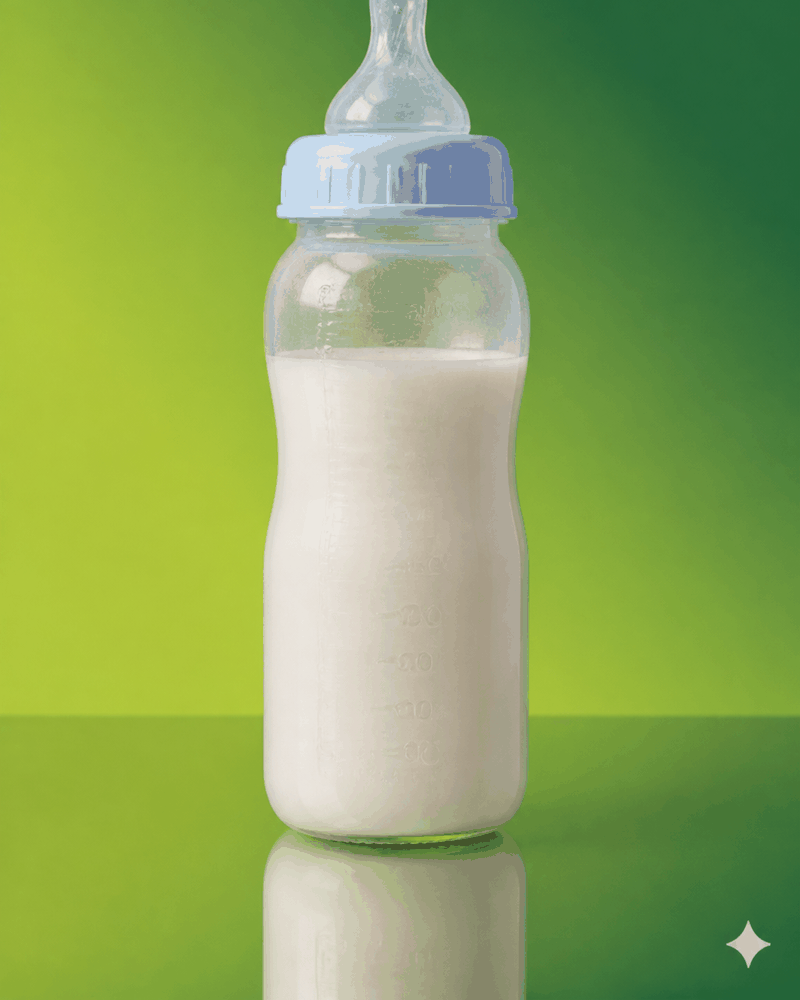 The Problem
 Plastic Baby Bottle
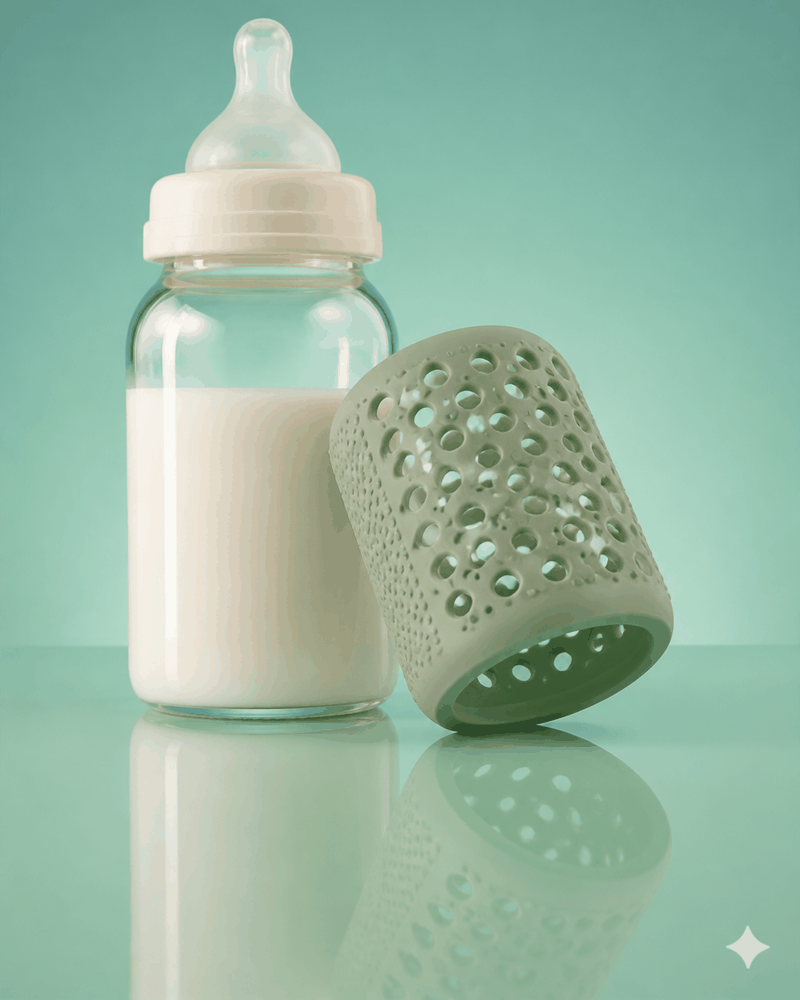 The Solution
 Glass Baby Bottle
Glass Baby Bottle
Replaces: Plastic Baby Bottle
Shop Now →Why Switch?
Infants are the most vulnerable group for any chemical exposure. They consume far more per kilogram of body weight than adults, their detoxification pathways are immature, and their brains and endocrine systems are actively developing. A formula-fed baby may get nearly all of its nutrition through one vessel for the better part of a year.
The landmark finding came in Nature Food in 2020. Researchers followed official WHO formula preparation guidelines — sterilise the bottle, prepare with water at 70°C, shake — using polypropylene infant feeding bottles, and found they released on the order of a million to sixteen million microplastic particles per litre, plus trillions of smaller nanoplastics. The heat is the mechanism, and the irony is sharp: the sterilisation and hot-water steps that make formula microbiologically safe are exactly what degrade the plastic. Extrapolating across regions, they estimated infants were ingesting well over a million particles a day.
Bisphenol A is the older concern, and it was taken seriously enough to act on: the EU banned BPA in infant feeding bottles in 2011, with Canada and others following. A study in Environmental Health Perspectives had shown that drinking from polycarbonate bottles raised urinary BPA concentrations substantially.
The catch is what replaced it. A study in Environmental Health tested a range of BPA-free plastic products and found that most released chemicals with detectable estrogenic activity, in some cases more than BPA-containing products did. A systematic review in Environmental Health Perspectives found that bisphenol S and F have hormonal activity comparable to BPA. As the review in Endocrine Reviews on low-dose effects and non-monotonic dose responses explains, for endocrine-active compounds a smaller dose is not reliably a safer one. So “BPA-free” tells you which single molecule was removed, not that the replacement is inert.
What Makes It Better
Borosilicate glass is genuinely inert. It has no plasticisers, no bisphenols, no polymer to degrade, and it does not shed particles no matter how often you boil it. Heat is the enemy of plastic and irrelevant to glass — you can sterilise a glass bottle in boiling water hundreds of times and it is chemically identical afterwards.
It also does not degrade in the ways plastic does. Plastic bottles cloud, scratch, retain odours, and stain, and those micro-scratches are where both bacteria and particle shedding increase; manufacturers generally recommend replacing them every few months. A glass bottle stays clear and smooth for years and can be handed down to the next child. Nothing leaches into breast milk or formula, so warming and storing are worry-free.
Honest Caveats
Glass is heavier and it breaks — that is the honest trade-off. A silicone sleeve solves most of it, adding grip and shatter protection, and it is what nearly everyone ends up using. Glass is less practical for a baby holding their own bottle and for nursery or daycare settings, many of which prohibit glass outright; food-grade silicone or stainless steel bottles are sensible alternatives there. If you do keep some plastic bottles, never prepare formula directly in them with hot water, never microwave them, avoid dishwashers, and replace them as soon as they cloud or scratch.
Key Benefits
- No microplastic or nanoplastic release, even with repeated boiling
- No BPA, and no BPS, BPF, or other bisphenol substitutes
- Fully sterilisable in boiling water without any material degradation
- Does not cloud, scratch, stain, or retain odours
- Lasts for years and through multiple children instead of months
- Nothing migrates into breast milk or formula when warming or storing
- Endlessly recyclable
The Research
- Li D., Shi Y., Yang L., et al. (2020). “Microplastic release from the degradation of polypropylene feeding bottles during infant formula preparation.” Nature Food.
- Carwile J.L., Luu H.T., Bassett L.S., et al. (2009). “Polycarbonate bottle use and urinary bisphenol A concentrations.” Environmental Health Perspectives.
- Bittner G.D., Yang C.Z., Stoner M.A. (2014). “Estrogenic chemicals often leach from BPA-free plastic products that are replacements for BPA-containing polycarbonate products.” Environmental Health.
- Rochester J.R., Bolden A.L. (2015). “Bisphenol S and F: A Systematic Review and Comparison of the Hormonal Activity of Bisphenol A Substitutes.” Environmental Health Perspectives.
- Vandenberg L.N., Colborn T., Hayes T.B., et al. (2012). “Hormones and endocrine-disrupting chemicals: low-dose effects and nonmonotonic dose responses.” Endocrine Reviews.
- European Commission Directive 2011/8/EU. “Restriction of use of Bisphenol A in plastic infant feeding bottles.”