
Natural Latex & Wool Mattress
Replaces: Memory Foam Mattress
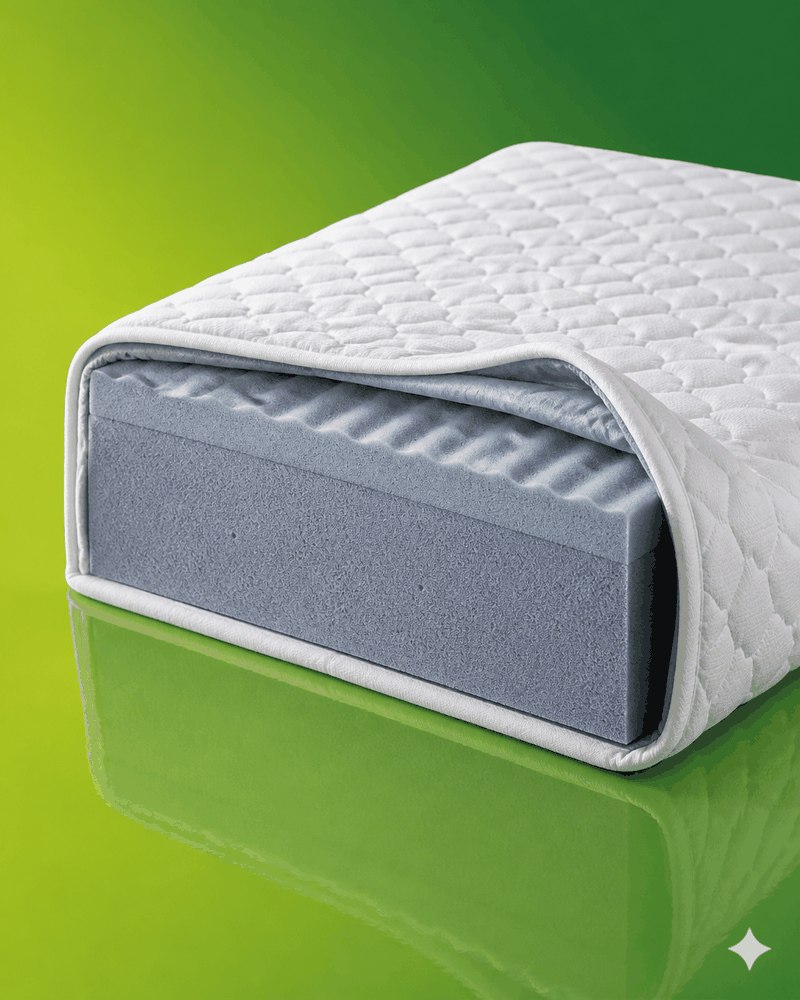 The Problem
 Memory Foam Mattress
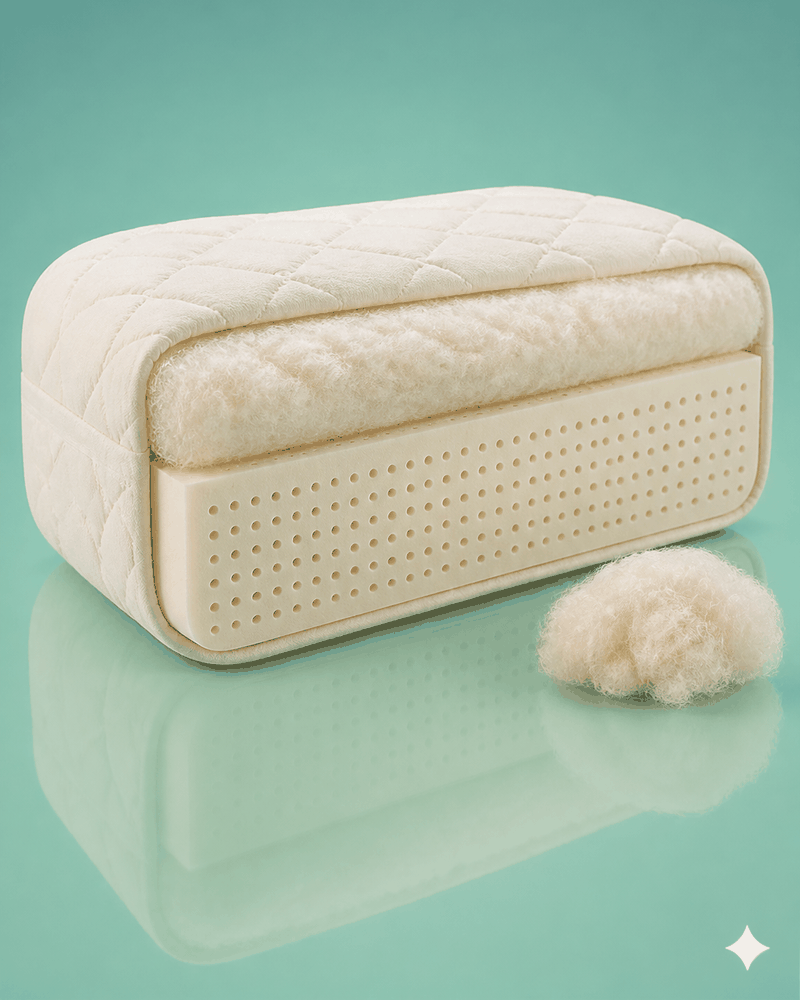 The Solution
 Natural Latex & Wool Mattress
Natural Latex & Wool Mattress
Replaces: Memory Foam Mattress
Shop Now →Why Switch?
Nothing else you own gets eight hours of direct, warm, close-range contact every single night. A mattress is a large slab of material a few centimetres from your airway, and body heat is the exact condition that drives chemical emissions upward.
A 2025 study from University of Toronto researchers published in Environmental Science & Technology made that concrete. Measuring emissions from children’s mattresses, they found that a sleeping child’s body heat and weight substantially increased releases of phthalates and flame retardants, creating a localised plume of elevated concentrations in the sleep microenvironment — the breathing zone right above the mattress. Earlier work in Indoor Air on crib mattresses had found similar VOC emissions, with new foam mattresses off-gassing considerably more than used ones and body heat raising emission rates.
Then there are flame retardants. To meet flammability regulations, polyurethane foam has historically been loaded with chemical retardants — first PBDEs, then organophosphate esters such as TDCIPP after PBDEs were phased out. Research in Environmental Science & Technology documented these compounds in furniture foam and in house dust throughout US homes, since they migrate out and accumulate in dust. A cohort study in Environmental Health Perspectives found that prenatal PBDE exposure was associated with poorer neurodevelopmental scores in children. And a paper in Environmental Science & Technology Letters asked directly whether the organophosphate replacements were a regrettable substitution, concluding the concerns largely carried over.
Memory foam also sleeps hot and traps moisture, because a dense closed-cell polyurethane slab does not breathe.
What Makes It Better
Natural latex is whipped and vulcanised rubber tree sap. It has an open-cell structure that actually moves air, and it is not petroleum-derived, so there is no polyurethane off-gassing and no isocyanate chemistry behind it.
The wool layer is the clever part. Wool is naturally flame resistant — it chars rather than melting and self-extinguishes — which lets manufacturers pass the same flammability standards using a physical barrier instead of a chemical treatment. That is how a mattress can legally contain no added flame retardants at all. Wool also regulates temperature and moisture remarkably well, wicking humidity away and buffering heat, which is why latex-and-wool beds sleep so much cooler than foam.
Durability is where the price starts to make sense. Natural latex resists compression and commonly lasts 15–25 years against the 7–10 typical of memory foam, so the cost per year of sleep is often comparable or better. It is also naturally resistant to dust mites and mould, and many latex beds are built in swappable layers, so you can change firmness or replace one layer instead of the whole bed.
Honest Caveats
This is the most expensive swap here, full stop, and it is genuinely difficult — mattresses are heavy, awkward, and not impulse purchases. Latex allergy is a real contraindication, though reactions to vulcanised latex foam are much rarer than to dipped latex products like gloves. Labelling is where most people get caught: “natural latex” is frequently a blend with synthetic styrene-butadiene rubber, so look for certification — GOLS for organic latex, GOTS for organic wool and cotton, and Oeko-Tex or GreenGuard Gold for emissions testing. Ask directly what percentage is natural latex. If a new mattress is out of reach, a wool mattress topper over your existing bed puts a breathable natural barrier between you and the foam for a small fraction of the cost.
Key Benefits
- No polyurethane VOC off-gassing in your breathing zone
- Wool acts as a natural flame barrier, so no added chemical flame retardants
- Open-cell latex and wool both breathe — sleeps significantly cooler
- Wool regulates moisture, keeping the bed dry through the night
- Naturally resistant to dust mites and mould
- Lasts 15–25 years versus 7–10 for memory foam
- Layered builds let you adjust firmness or replace a single layer
The Research
- University of Toronto / Diamond research group (2025). Studies on semi-volatile organic compound emissions and children’s exposure in the sleep microenvironment. Environmental Science & Technology.
- Boor B.E., Järnström H., Novoselac A., Xu Y. (2014). “Infant exposure to emissions of volatile organic compounds from crib mattresses.” Indoor Air.
- Stapleton H.M., Klosterhaus S., Eagle S., et al. (2009). “Detection of organophosphate flame retardants in furniture foam and U.S. house dust.” Environmental Science & Technology.
- Herbstman J.B., Sjödin A., Kurzon M., et al. (2010). “Prenatal exposure to PBDEs and neurodevelopment.” Environmental Health Perspectives.
- Blum A., Behl M., Birnbaum L.S., et al. (2019). “Organophosphate Ester Flame Retardants: Are They a Regrettable Substitution for Polybrominated Diphenyl Ethers?” Environmental Science & Technology Letters.