
Induction Cooktop
Replaces: Gas Stove
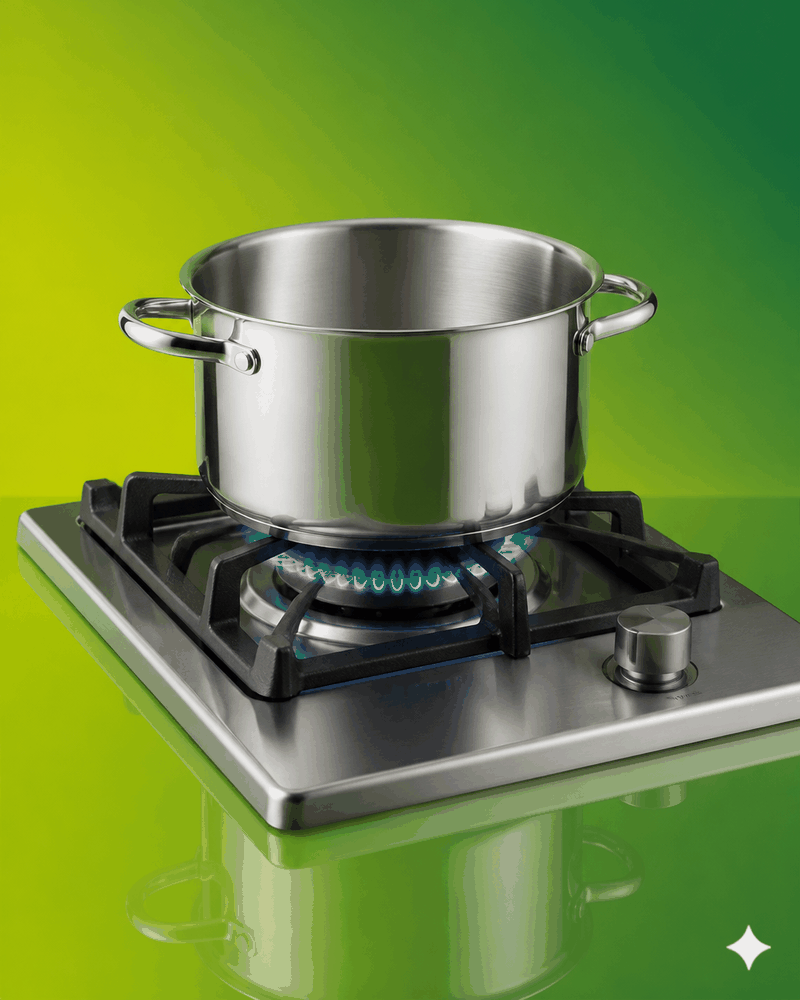 The Problem
 Gas Stove
 The Solution
 Induction Cooktop
Induction Cooktop
Replaces: Gas Stove
Shop Now →Why Switch?
There are two separate, well-measured problems here, and they are worth keeping apart because the evidence for them is much stronger than the evidence for any particular disease outcome.
Combustion products. A 2022 study in Environmental Science & Technology measured NOx in 32 California homes and found emissions scaled linearly with gas burned, averaging 21.7 ng NOx per joule. The authors concluded that households without a working range hood, or with poor ventilation, can exceed the US 1-hour NO₂ standard of 100 ppb within minutes of lighting a burner — particularly in small kitchens.
Unburned gas. This is the more surprising finding. Researchers sampling 234 unburned gas samples from 69 Greater Boston homes, reporting in Environmental Science & Technology, identified 296 non-methane VOCs, 21 of them EPA-designated hazardous air pollutants. Benzene appeared in 95% of samples, hexane in 98%, toluene in 94%. They also calculated from odorant levels that methane could reach around 21 ppmv indoors while staying below the smell threshold — small leaks genuinely can go unnoticed. Benzene is an IARC Group 1 human carcinogen.
A 2023 study in Environmental Science & Technology then tied combustion to benzene directly across 87 homes in California and Colorado: gas and propane burners on high, and ovens at 350°F, emitted 10–25 times more benzene than electric coil and radiant stoves, and that benzene migrated into bedrooms, where concentrations sometimes stayed above chronic health benchmarks for hours after the stove was off. The food being cooked emitted none, which isolates the fuel and flame as the source.
On asthma, a meta-analysis of 41 studies in the International Journal of Epidemiology reported a summary odds ratio of 1.32 (95% CI 1.18–1.48) for childhood asthma with gas cooking. You may have seen the headline that gas stoves cause about 13% of US childhood asthma — that comes from a 2023 modelling paper in the International Journal of Environmental Research and Public Health estimating a population attributable fraction of 12.7%. Treat that number with caution. It has been forcefully criticised in Global Epidemiology on two grounds: that it inserts an adjusted odds ratio into a formula assuming an unadjusted one, and that a population attributable fraction only means what people think it means if the underlying relationship is causal. The underlying epidemiology is largely cross-sectional and self-reported, the few cohort studies have mostly returned null results, and in the meta-analysis above the indoor NO₂–asthma association was itself null. Worth noting on both sides: the critical commentaries come from authors at a private consulting firm with gas industry funding, while several of the emissions papers come from advocacy-adjacent research groups.
The honest summary is this: gas stoves demonstrably put NO₂ and benzene into your home at levels that can exceed health benchmarks, and the size of the resulting asthma burden is genuinely unsettled.
What Makes It Better
Induction removes both pathways at the source. There is no combustion, so no NO₂, carbon monoxide, or combustion-formed benzene, and no gas line into the appliance, so no unburned-gas leakage between uses. This is measured rather than assumed — the 2023 benzene study reported that induction stoves emitted no detectable benzene at all.
It is also better to cook on. Induction puts roughly 85–90% of its energy into the pan versus about 40% for gas, so it boils water noticeably faster, responds to a dial change instantly, and holds a low simmer without hot spots. Spills do not bake onto burner grates, and the kitchen stays dramatically cooler, since a gas flame spends much of its heat warming the room.
One reason to change the appliance rather than rely on a hood: hoods underperform badly. A 2012 assessment in Environmental Science & Technology bench-tested seven common US residential exhaust hoods and measured capture efficiencies ranging from under 15% to over 98%, with front burners far worse than back ones — and capture efficiency under 30% for front and oven burners among hoods that met Energy Star criteria. A companion field study found 10 of 15 installed units delivered airflow at or below 70% of their advertised figures. The benzene study likewise found hoods were not always effective even when vented outdoors.
Honest Caveats
This is the most expensive swap on the site and often needs an electrician, since a built-in induction hob usually wants a dedicated high-amperage circuit. Your cookware has to be magnetic — cast iron and most stainless steel work, aluminium and copper do not, and a fridge magnet settles it in seconds.
Induction does not eliminate all cooking pollution. Searing, frying, and hot oil generate fine and ultrafine particles from the food itself, and no change of appliance touches that. Keep ventilating after you switch. A portable single-hob induction unit is a partial substitute, not a range replacement, and if replacing the hob is out of reach, using a properly vented hood on its highest setting with back burners every single time you light a flame captures a meaningful part of the benefit.
Key Benefits
- No combustion, so no indoor NO₂, carbon monoxide, or formaldehyde
- No gas line, so no benzene or other hazardous air pollutants leaking while the hob is off
- Measured to emit no detectable benzene, unlike gas and propane burners
- Boils faster and responds instantly, at 85–90% energy efficiency
- Flat surface wipes clean; nothing bakes onto burner grates
- Keeps the kitchen far cooler in summer
- No open flame, and the surface cools quickly
The Research
- Lebel E.D., Finnegan C.J., Ouyang Z., Jackson R.B. (2022). “Methane and NOx Emissions from Natural Gas Stoves, Cooktops, and Ovens in Residential Homes.” Environmental Science & Technology. — doi.org/10.1021/acs.est.1c04707
- Michanowicz D.R., et al. (2022). “Home is Where the Pipeline Ends: Characterization of Volatile Organic Compounds Present in Natural Gas at the Point of the Residential End User.” Environmental Science & Technology. — doi.org/10.1021/acs.est.1c08298
- Kashtan Y.S., et al. (2023). “Gas and Propane Combustion from Stoves Emits Benzene and Increases Indoor Air Pollution.” Environmental Science & Technology. — pmc.ncbi.nlm.nih.gov/articles/PMC10324305
- Lin W., Brunekreef B., Gehring U. (2013). “Meta-analysis of the effects of indoor nitrogen dioxide and gas cooking on asthma and wheeze in children.” International Journal of Epidemiology. — doi.org/10.1093/ije/dyt150
- Gruenwald T., Seals B.A., Knibbs L.D., Hosgood H.D. (2023). “Population Attributable Fraction of Gas Stoves and Childhood Asthma in the United States.” International Journal of Environmental Research and Public Health. — doi.org/10.3390/ijerph20010075
- Delp W.W., Singer B.C. (2012). “Performance Assessment of U.S. Residential Cooking Exhaust Hoods.” Environmental Science & Technology. — doi.org/10.1021/es3001079
The contested view, for balance
- Cox L.A. Jr. (2023). “The gas stove-childhood asthma kerfuffle: A teaching opportunity.” Global Epidemiology. — doi.org/10.1016/j.gloepi.2023.100104
- Li W., et al. (2023). “Gas cooking and respiratory outcomes in children: A systematic review.” Global Epidemiology. — pubmed.ncbi.nlm.nih.gov/37638371
- Li W., Goodman J.E., Long C. (2024). “Population attributable fraction of gas cooking and childhood asthma: What was missed?” Global Epidemiology. — doi.org/10.1016/j.gloepi.2024.100141