
Water-Based Nail Polish
Replaces: Conventional Nail Polish
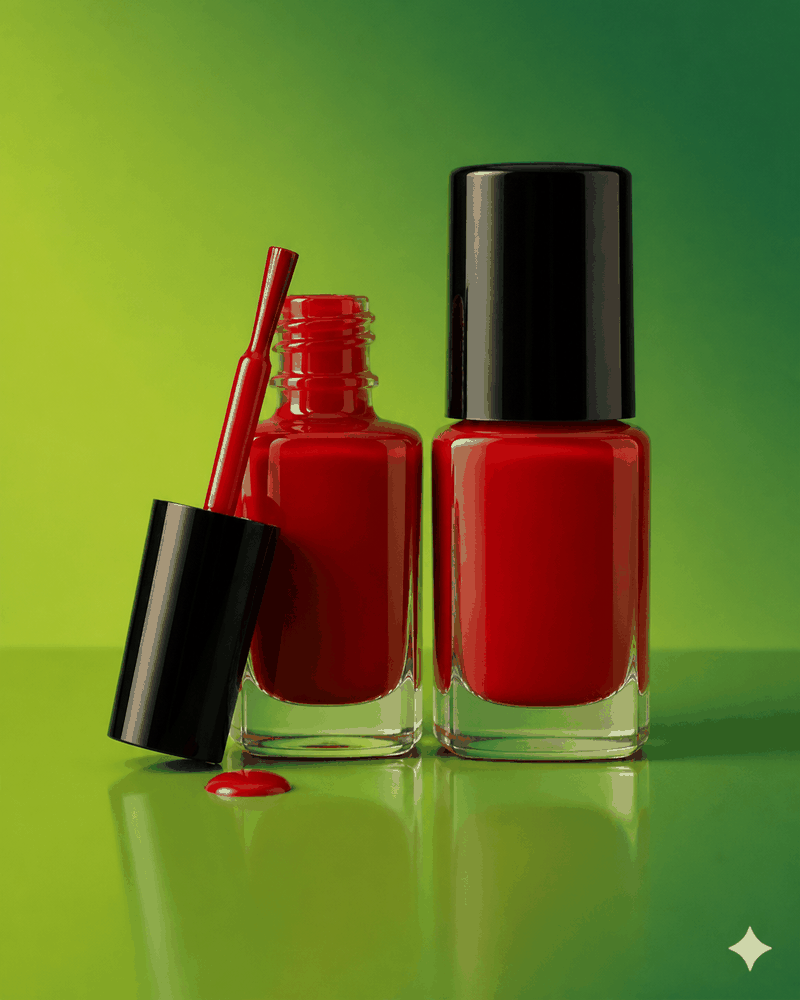 The Problem
 Conventional Nail Polish
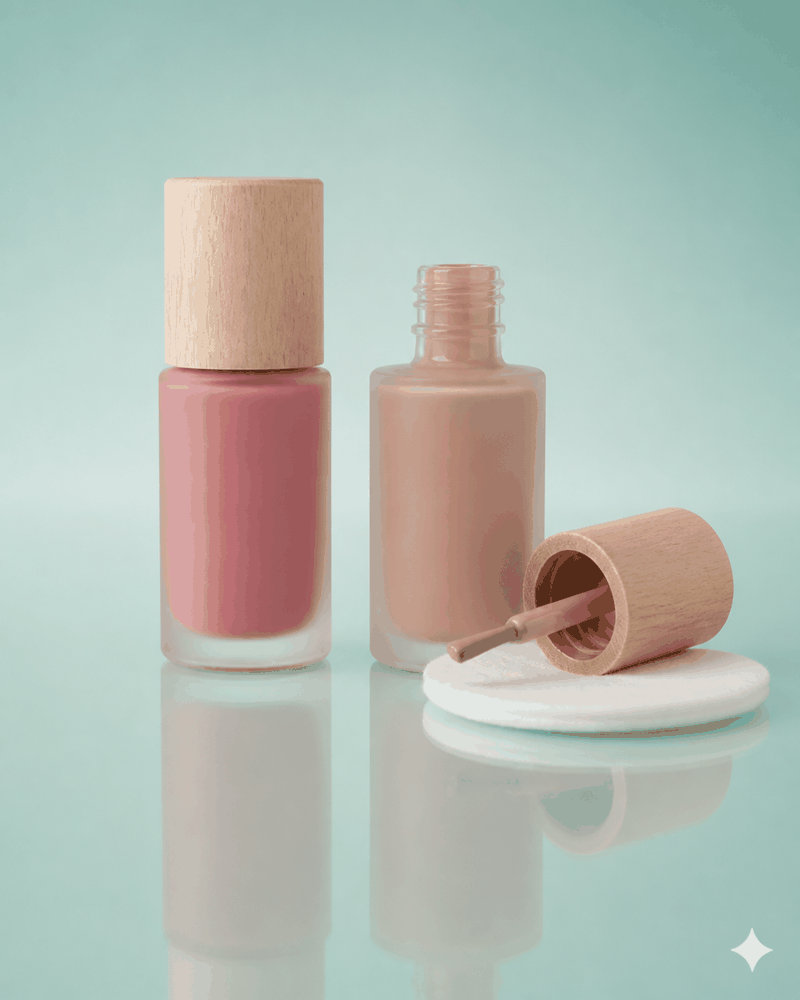 The Solution
 Water-Based Nail Polish
Water-Based Nail Polish
Replaces: Conventional Nail Polish
Shop Now →Why Switch?
The usual assumption is that polish sits harmlessly on top of an inert nail. A 2016 study in Environment International by Duke University and EWG researchers tested that directly, and it did not hold up.
They found triphenyl phosphate — TPHP, a plasticiser added to keep polish flexible — at up to 1.68% by weight in eight of ten polishes bought at US pharmacies and department stores, including two that did not list it as an ingredient. Then they measured its metabolite, diphenyl phosphate, in the urine of 26 women across 411 samples. Levels rose nearly sevenfold within 10–14 hours of painting their nails. The elegant part is how they isolated the route: ten participants painted their own nails on one occasion and synthetic nails glued to gloves on another. Gloved application produced a markedly smaller rise, which means the dominant pathway is dermal absorption through the nail bed and surrounding skin, not inhalation. A separate study in Chemosphere independently confirmed dermal absorption as a major pathway for phosphorus-based plasticisers in polish.
The classic “toxic trio” is the older concern. Toluene is a developmental neurotoxicant and a California Proposition 65 developmental toxicant. Formaldehyde, used as a hardener, is an IARC Group 1 human carcinogen. Dibutyl phthalate showed a clear antiandrogenic pattern in rats — reduced anogenital distance, underdeveloped epididymis, hypospadias — in work published in Toxicological Sciences, which is why it is now prohibited in EU cosmetics.
Occupational exposure is measurable. A study in Indoor Air found nail technicians’ post-shift blood toluene roughly doubled against pre-shift levels, with salon air toluene at a median 100 µg/m³ and ventilation frequently below the ASHRAE guideline. A companion study in Environmental Science & Technology found post-shift urinary increases across phthalates, phthalate alternatives, and organophosphate esters.
What Makes It Better
Removing TPHP from the bottle demonstrably lowers the internal dose — that within-person biomonitoring design is the strongest single claim available here.
Reformulation has partly worked, too. A 2018 study in Environmental Science & Technology measured 12 phthalates and 10 organophosphate plasticisers across 40 polishes from 12 brands, and found polishes labelled 5-Free through 13-Free had dramatically lower TPHP than unlabelled or 3-Free ones: a median below 0.002 µg/g versus 3,730 µg/g.
Water-based polish replaces the solvent system entirely, using an acrylic polymer dispersion in water instead of nitrocellulose in toluene, ethyl acetate, and butyl acetate. That is why the aromatic solvents drop out and the smell is so much fainter. It also removes the reason the plasticiser was there: TPHP and DBP exist to stop a hard solvent-based film cracking, and a water-based acrylic film is flexible on its own. Most water-based formulas are peelable, so you can remove them without acetone, which is what actually dries out nails over time. That makes it the sensible pick during pregnancy and the standard recommendation for children.
In the EU, note that DBP is prohibited and formaldehyde was moved to the banned annex in 2019, so “3-free” is table stakes there rather than a selling point.
Honest Caveats
“Non-toxic” and “n-free” labels are frequently inaccurate, and this is the most important thing on this page. California’s Department of Toxic Substances Control tested 25 nail products and found that ten of twelve products claiming to be “toluene-free” contained toluene, at up to 177,000 ppm — 17.7% by weight — and that five of seven “three-free” claims could not be substantiated. The 2018 label study found “10-Free” had six different definitions across brands, and documented regrettable substitution: samples without TPHP had significantly higher DEHP, swapping one endocrine-disrupting plasticiser for another. There is no US pre-market ingredient review for nail polish, so these claims are self-declared. Read the actual ingredient list; do not trust the number on the front.
“Water-based is better” is the weakest claim here. I could find no peer-reviewed head-to-head biomonitoring or chamber comparison of water-based versus conventional polish. The best available comparison found only about a 14% difference in total VOC content — the meaningful difference was qualitative, with BTEX compounds present in solvent-based and absent in water-based. Water-based formulas also bring their own trade-offs that are poorly studied: N-methylpyrrolidone and triethylamine have appeared among their dominant VOCs, and NMP is itself classified as a reproductive toxicant under EU CLP.
Performance is genuinely worse. Water-based polish chips faster, air-dries more slowly, and gives less glossy, less opaque colour. Thin coats on a completely oil-free nail with real drying time between them, plus a compatible water-based top coat, make the difference. It does not survive prolonged soaking in hot water.
Don’t overstate the harm. The TPHP study established exposure, not disease — no study links nail polish TPHP to a clinical outcome in humans. TPHP’s metabolic effects come from cell culture and animal dosing well above consumer exposure, so it is a suspected metabolism-disrupting chemical, not an established human obesogen. The DBP rat malformations occurred at 250–750 mg/kg/day, orders of magnitude above what polish delivers. And the salon-worker studies are small pilots (around ten participants each) in settings with eight-hour daily exposure and poor ventilation — strong grounds for worker protection, weak grounds for conclusions about painting your nails twice a month.
If water-based does not work for you, a “5-free or better” solvent polish applied in a well-ventilated room is still a real improvement over the toxic trio.
Key Benefits
- Avoids triphenyl phosphate, shown to absorb through nail and skin and raise urinary metabolites sevenfold
- Free of the toluene, dibutyl phthalate, and formaldehyde “toxic trio”
- Water carrier means far fewer solvent fumes and no BTEX aromatics
- Usually peelable, so no acetone remover drying out your nails
- A sensible option during pregnancy and the clear choice for children
- Much less odour, so no need to ventilate the room or wait it out
The Research
- Mendelsohn E., Hagopian A., Hoffman K., et al. (2016). “Nail polish as a source of exposure to triphenyl phosphate.” Environment International. — pmc.ncbi.nlm.nih.gov/articles/PMC4662901
- Young A.S., Allen J.G., Kim U.-J., et al. (2018). “Phthalate and Organophosphate Plasticizers in Nail Polish: Evaluation of Labels and Ingredients.” Environmental Science & Technology. — pmc.ncbi.nlm.nih.gov/articles/PMC6222550
- Tokumura M., Seo M., Wang Q., et al. (2019). “Dermal exposure to plasticizers in nail polishes: An alternative major exposure pathway of phosphorus-based compounds.” Chemosphere. — pubmed.ncbi.nlm.nih.gov/30939370
- Cano-Sancho G., Smith A.R., La Merrill M.A. (2017). “Triphenyl phosphate enhances adipogenic differentiation, glucose uptake and lipolysis via endocrine and noradrenergic mechanisms.” Toxicology in Vitro. — pmc.ncbi.nlm.nih.gov/articles/PMC6377152
- Mylchreest E., Cattley R.C., Foster P.M.D. (1998). “Male Reproductive Tract Malformations in Rats Following Gestational and Lactational Exposure to Di(n-butyl) Phthalate: An Antiandrogenic Mechanism?” Toxicological Sciences. — pubmed.ncbi.nlm.nih.gov/9629619
- Ceballos D.M., Craig J., Fu X., et al. (2019). “Biological and environmental exposure monitoring of volatile organic compounds among nail technicians in the Greater Boston area.” Indoor Air. — pmc.ncbi.nlm.nih.gov/articles/PMC6565444
- Craig J.A., Ceballos D.M., Fruh V., et al. (2019). “Exposure of Nail Salon Workers to Phthalates, Di(2-ethylhexyl) Terephthalate, and Organophosphate Esters: A Pilot Study.” Environmental Science & Technology. — pmc.ncbi.nlm.nih.gov/articles/PMC7192361
- California Department of Toxic Substances Control (2022). “Chemicals in Nail Products Background Document.” California EPA / DTSC. — dtsc.ca.gov