
Dried Beans in a Glass Jar
Replaces: BPA-Lined Can
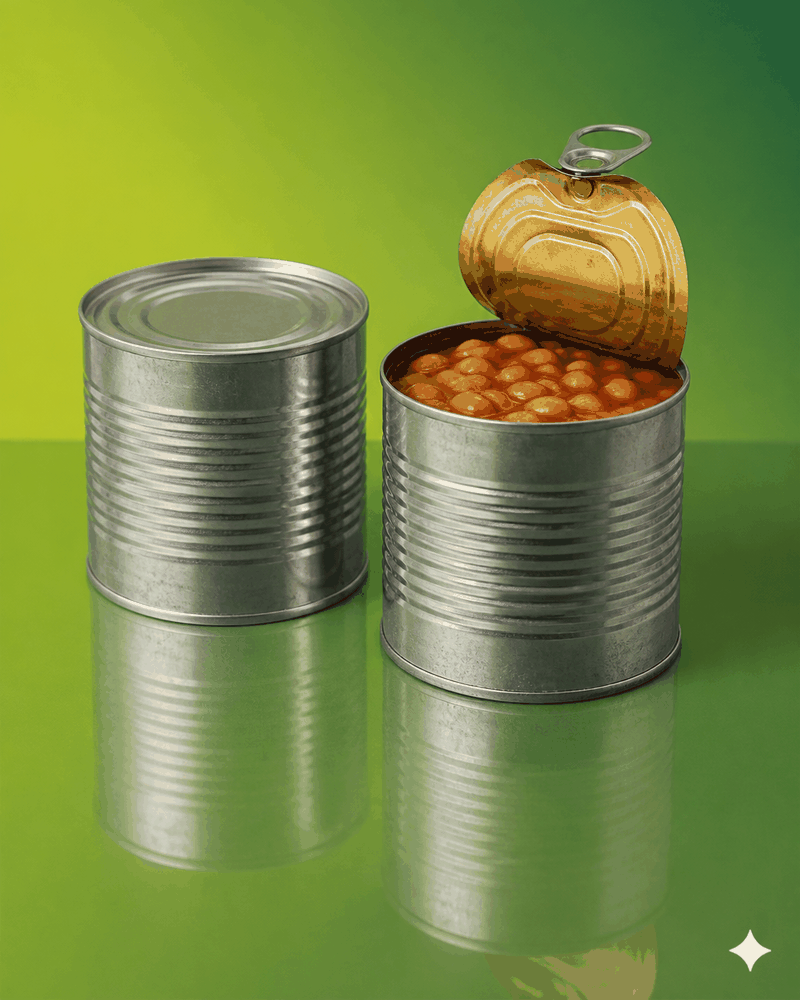 The Problem
 BPA-Lined Can
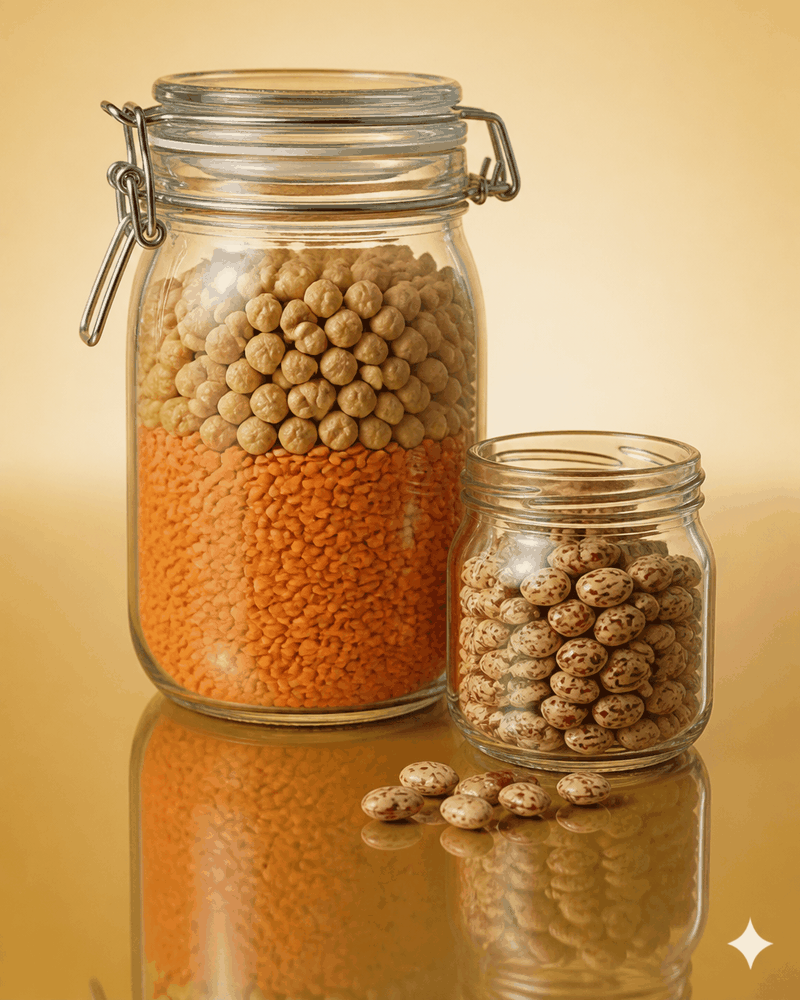 The Solution
 Dried Beans in a Glass Jar
Dried Beans in a Glass Jar
Replaces: BPA-Lined Can
Shop Now →Why Switch?
Most food cans are lined inside with a thin epoxy film made from bisphenol A, to stop the metal corroding. Residual BPA migrates from that lining into the contents during processing and storage.
FDA scientists quantified it. A 2011 survey in the Journal of Agricultural and Food Chemistry tested 78 canned and 2 frozen US food products covering food classes representing about 65% of US canned-food sales. BPA was detected in 71 of the 78 canned samples, at 2.6–730 ng/g, and in neither frozen sample. Concentrations varied enormously between products of the same type and even between lots of the same product, and BPA tended to partition into the solid portion of the food.
Two human studies then show it reaches you, and that it is reversible. A randomised crossover trial in JAMA had 75 participants eat 12 oz of canned or fresh soup daily for five days, with a washout and crossover. Urinary BPA was 1.1 µg/L after fresh soup and 20.8 µg/L after canned — a 1,221% increase — with BPA detected in 100% of post-canned samples. Because it is the same people eating the same kind of soup from a different container, this is about as clean a demonstration of packaging as the cause as this field offers. A dietary intervention study in Environmental Health Perspectives found the mirror image: removing canned and plastic-packaged food for three days and storing food in glass and stainless steel cut geometric mean urinary BPA by 66%.
On how much matters, the picture is genuinely disputed and we are not going to pretend otherwise. In 2023 the European Food Safety Authority re-evaluated BPA, identified the immune system as the most sensitive target, and set a tolerable daily intake of 0.2 ng/kg body weight per day — about 20,000 times lower than its previous temporary value — concluding that dietary exposure across all age groups exceeds it. Germany’s Federal Institute for Risk Assessment rejected that conclusion, arguing the immune endpoint’s human relevance is questionable and that EFSA’s study-exclusion approach departed from accepted practice, and derived a TDI of 0.2 µg/kg/day — a thousand times higher than EFSA’s. The European Medicines Agency also dissented, and the agencies’ formal divergence report concluded that convergence was not possible. So “BPA exposure exceeds safe levels by orders of magnitude” is EFSA’s position specifically, not a European consensus.
“BPA-free” is not automatically the answer either. A systematic review in Environmental Health Perspectives found bisphenol S and F have hormonal potencies in the same order of magnitude as BPA. That is in vitro and animal evidence of hormonal activity, so the fair conclusion is that the substitutes are not demonstrated to be safer — not that they are proven equally harmful.
What Makes It Better
Dried beans cooked at home involve no epoxy-lined contact surface anywhere. Glass is inert and needs no lining, which is exactly the storage material used in the intervention study above where BPA dropped by two-thirds in three days.
You also get better food. Home-cooked beans have firmer texture and much better flavour than the soft, faintly metallic canned version, and you control the salt completely instead of inheriting the 400-plus milligrams of sodium in a typical can.
The economics are striking. Dried beans cost roughly a quarter to a fifth as much per cooked cup, keep for years in a sealed jar, and need no refrigeration. A pressure cooker gets unsoaked beans done in 25–40 minutes with no planning; on the stove, an overnight soak plus an hour of simmering does it. Cook a big batch and freeze it in portions and you have your own “cans” on demand.
Honest Caveats
This takes planning, which is why it is medium effort — beans do not appear in 90 seconds. And it is worth being clear that canned beans are far better than no beans. They are cheap, shelf-stable, nutritionally valuable, and for many households the practical way to eat legumes at all; talking someone out of them entirely would be a net harm. The FDA survey also found the risk is not uniform — canned fruit and tuna were at the low end, and lot-to-lot variation was large.
If you want the convenience, beans in glass jars are widely sold, and some brands now use non-bisphenol linings such as oleoresin or acrylic, though labelling is inconsistent enough that you often have to ask the manufacturer. Cartons are not a verified-clean alternative; their liners are a separate, less-characterised material, so we are not claiming they are inert. Glass and home-cooked dried beans are the options the evidence actually supports.
One more limit worth stating: the JAMA trial used one soup brand in one university population with a median age of 27, and measured a likely transient spike rather than long-term body burden. And BPA’s human health effects remain associations — EFSA itself acknowledges no study proves a causal link between BPA intake and immune effects in people.
Key Benefits
- No epoxy lining, so no BPA, BPS, or BPF migrating into your food
- Removes the exposure source isolated by a randomised crossover trial
- Roughly four to five times cheaper per cooked cup than canned
- You set the salt — canned beans arrive pre-salted
- Better texture and flavour, with no metallic note
- Years of shelf life in a sealed glass jar, no refrigeration needed
The Research
- Noonan G.O., Ackerman L.K., Begley T.H. (2011). “Concentration of Bisphenol A in Highly Consumed Canned Foods on the U.S. Market.” Journal of Agricultural and Food Chemistry. — doi.org/10.1021/jf201076f
- Carwile J.L., et al. (2011). “Canned Soup Consumption and Urinary Bisphenol A: A Randomized Crossover Trial.” JAMA. — doi.org/10.1001/jama.2011.1721
- Rudel R.A., et al. (2011). “Food Packaging and Bisphenol A and Bis(2-Ethyhexyl) Phthalate Exposure: Findings from a Dietary Intervention.” Environmental Health Perspectives. — pmc.ncbi.nlm.nih.gov/articles/PMC3223004
- EFSA Panel on Food Contact Materials, Enzymes and Processing Aids (2023). “Re-evaluation of the risks to public health related to the presence of bisphenol A (BPA) in foodstuffs.” EFSA Journal. — doi.org/10.2903/j.efsa.2023.6857
- Rochester J.R., Bolden A.L. (2015). “Bisphenol S and F: A Systematic Review and Comparison of the Hormonal Activity of Bisphenol A Substitutes.” Environmental Health Perspectives. — doi.org/10.1289/ehp.1408989
The dissenting assessment, for balance
- German Federal Institute for Risk Assessment (2023). “Bisphenol A: BfR proposes health based guidance value, current exposure data are needed for a full risk assessment.” BfR Opinion No. 018/2023. — doi.org/10.17590/20230419-114234-0
- BfR and EFSA (2023). Joint divergence report under Regulation (EC) 178/2002. — efsa.europa.eu